Local SEO for Service Businesses
Local SEO is the work that helps your business show up when people nearby search for what you do: on Google Maps, in the regular results and in AI answers. With BrickByClick, our team does that work every month on the Growth and Total Growth plans, and your CRM shows where you stand, month by month. Nobody can promise a ranking, and we do not.
At a glance
- What you get: monthly work on your website, your Google Business Profile, your directory listings and your blog, plus a monthly strategy call.
- What you can see: your Google searches, your spot on Google Maps from 49 points around you, and whether AI assistants name you.
- Who it is for: local service businesses in 30+ industries that serve a town or a service area.
- What it costs: included in Growth at $599 a month and Total Growth at $999 a month. Not in Starter.
- How fast: setup work comes first. Rankings take months and no one can say how many.
- What it needs: a live website, your business details and a monthly strategy call.
What is local SEO for service businesses?
The short version
SEO means making your business easy for search engines to find and trust. Local SEO narrows that to people searching near you: "plumber near me", "house cleaning in Springfield", "roof repair Round Rock".
It covers three places you can show up: the map with a few businesses at the top, the regular search results below it, and the answers AI assistants give.
What Google looks at
Google describes local results as depending mainly on relevance, distance and prominence. Here is what each means for a service business.
- Relevance: does your business match the search? Your Google categories and services, and a page on your website for each service and town you cover.
- Distance: how close you are to the person searching. Nobody can change this, so the work goes into setting your address or service area correctly.
- Prominence: how well known you are. Your reviews, your business details listed the same way on other sites, links from other websites and a profile that is kept up to date.
How local SEO differs from regular SEO
Regular SEO tries to rank a website for a topic anywhere. Local SEO ranks a business for a place.
That makes your Google Business Profile, your reviews and your listings on other sites count as much as your website does. A customer in the next town over may see a different map than you do.
Where BrickByClick fits
Your CRM has an SEO page where you can see your Google searches, your map spots and your AI check. On Growth and Total Growth, our team also does the monthly work. See SEO services for the whole list.
Why does local SEO matter for a service business?
People search before they call
When a pipe bursts or the furnace stops, people pick up their phone and search. The businesses they see first get the first call.
If you are not on the map or in the results for the work you do, those calls go to someone else, however good your work is.
The map gets the first look
For a local search, Google puts a small group of businesses with the map above the regular results. Where you land in that group, and in which parts of your service area, is what the map rankings in your CRM measure.
It keeps building, unlike a one-off fix
Reviews, listings, service pages and blog posts stay in place. Paid ads stop the day you stop paying for them.
Local SEO is slower, and it is also something you keep. That trade is why it works best alongside referrals and word of mouth, not instead of them.
Answers now come from AI too
More people ask an AI assistant "who is a good electrician near me?" instead of scrolling results. We cover that in how AI assistants pick local businesses.
How does local SEO work with BrickByClick?
The monthly cycle
- Setup: we set up your Google Business Profile, or start managing the one you have, and look at your website's pages, titles and structure.
- Every month: our team works through the list below and logs what it did in your SEO page, under "What we did".
- Your drafts: a blog post draft is written for you to read, change and approve. Our team then puts it on your website, and you get a message when it is live.
- The numbers: on the 1st you get your monthly business report. The SEO page shows your Google searches, map spots and AI check.
- The strategy call: once a month we go over what was done, what came in and what to work on next.
What our team does on Growth and Total Growth
- On-page work on your website (on-site SEO).
- Your Google profile set up and kept current (Google Business Profile management).
- Directory listings built and fixed so your details match everywhere (citations).
- Blog posts put on your website: 1 a month on Growth, 2 a month on Total Growth.
- A monthly strategy call, set up with you by our team.
- Total Growth only: local link building (backlinks).
What you can do yourself in the CRM
The SEO page has nine tabs: Overview, Results, Map rankings, AI search, Blog, Reviews, Google & listings, Website check and Local links. Owners and office staff can open it; crew members cannot.
- Ask for blog topic ideas, write a post from your own details and edit it.
- Paste in a review to get a reply written, or write a Google post draft, then copy it and post it yourself.
- Run a website check that lists what to fix on your home page.
- Write a request email to a chamber of commerce or a supplier, from your own email address.
It writes drafts. It never posts to Google, Facebook or Yelp for you, and it sends no email to anyone but you.
What does local SEO include every month?
A website Google can read
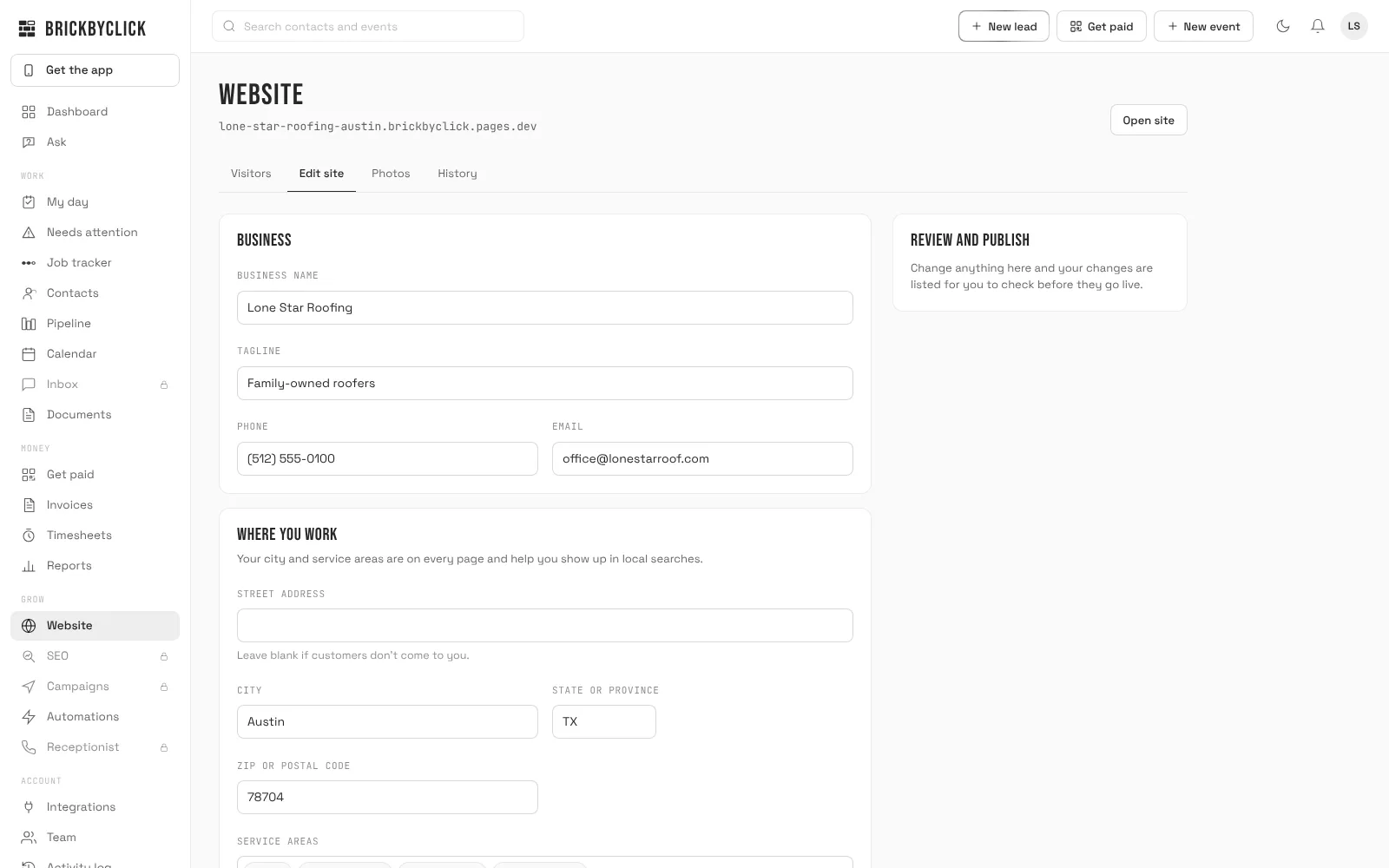
A page for each service and the towns you serve, with clear titles, descriptions and headings. Your city and service areas appear on every page. Our on-site SEO work covers the page-level details, and web hosting covers where the site lives.
A Google profile that is complete
The profile decides your Google Maps result more than almost anything else on this list. The SEO page has an 11-point checklist: category, other categories, services, service area, hours, description, 10 or more photos, a weekly post, questions and answers, links and replies to reviews.
On Growth and Total Growth our team keeps the profile managed. Details are on the Google Business Profile page.
Listings that match
Your name, address and phone number should read the same on every directory that lists you. Our team builds the listings you are missing and fixes the ones that are wrong. The citations page explains how this works.
Blog posts about what customers ask
A post answers a real question, such as "water heater leaking, what do I do first?". The draft uses only the details you give it, so you check every fact before you approve it.
If you use the AI receptionist, it records questions callers ask. When a question has come up 3 times, you get a notice and can turn it into a blog post with one button.
Reviews
Reviews are part of how well known you are. With the switch on and your review link saved, customers get one email the day after a job is done (3 days after if the "How did we do?" check is on), between 9 AM and 7 PM. The same customer is not asked again for 180 days. These are emails, not texts. See review software.
Local links (Total Growth)
Links from real local sites help Google trust you. Total Growth adds link work, covered on the backlinks page. We do not buy links.
How do you track local SEO results?
You can see local SEO in three places: how you show up on the map, what people searched on Google, and which customers said they found you that way.
Map rankings: your spot across your area
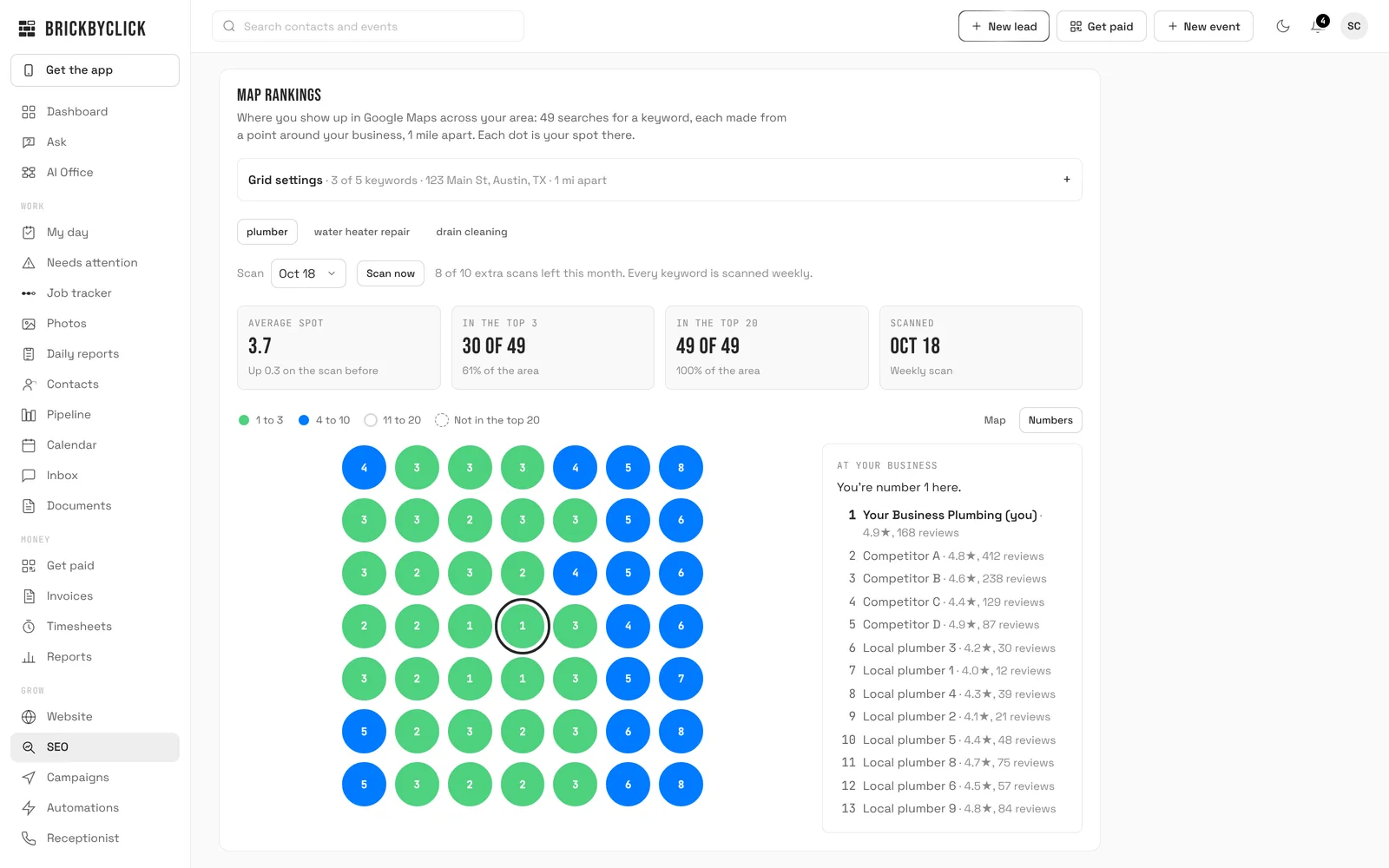
For each keyword, Google Maps is searched from 49 points around your business, in a 7 by 7 grid. Each dot shows your spot from there, and a scan takes about a minute.
- Growth: 3 keywords, scanned once a month, with 3 extra "Scan now" scans a month.
- Total Growth: 5 keywords, scanned every week, with 10 extra scans a month, plus a table of the businesses you are up against.
- A point where you are not in the top 20 counts as spot 21 when the average is worked out.
Keywords, month by month
Connect Google (read-only) and you see what people searched before they found you: clicks, times you showed up and your average spot, against the 28 days before. You can track up to 10 keywords and see each one's spot for the last 12 months.
Google's numbers run about two days behind.
What SEO brought in
The Results tab counts visits from search, taps to call, forms sent, online bookings and requests for directions, and the leads, jobs won and money from customers who found you on Google. Only customers who told you how they found you, or who came through your website, are counted. It is the least SEO brought in, not all of it.
If your website was built elsewhere, a visit counter has to be added to your pages first, otherwise only the CRM numbers show.
Your monthly report
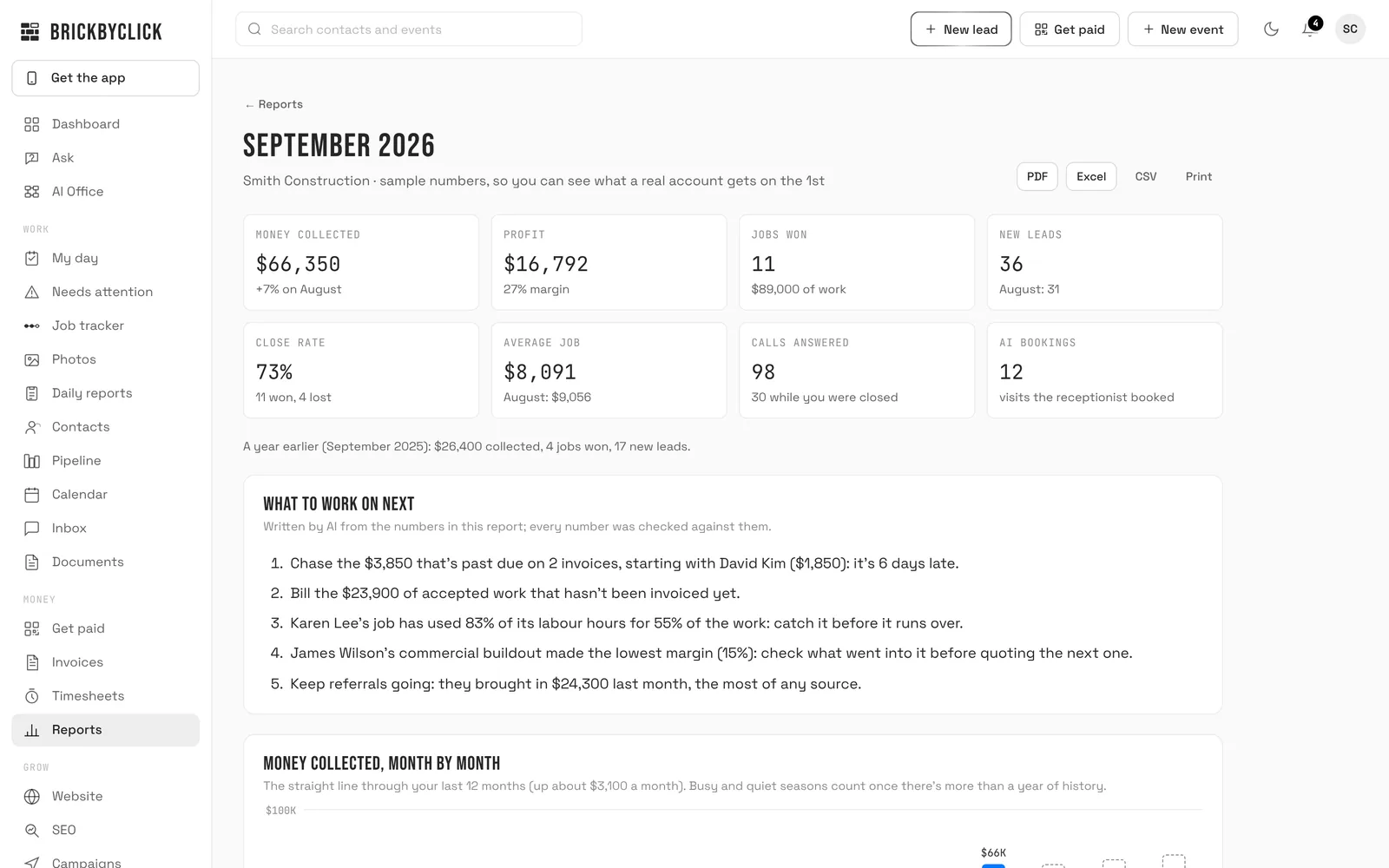
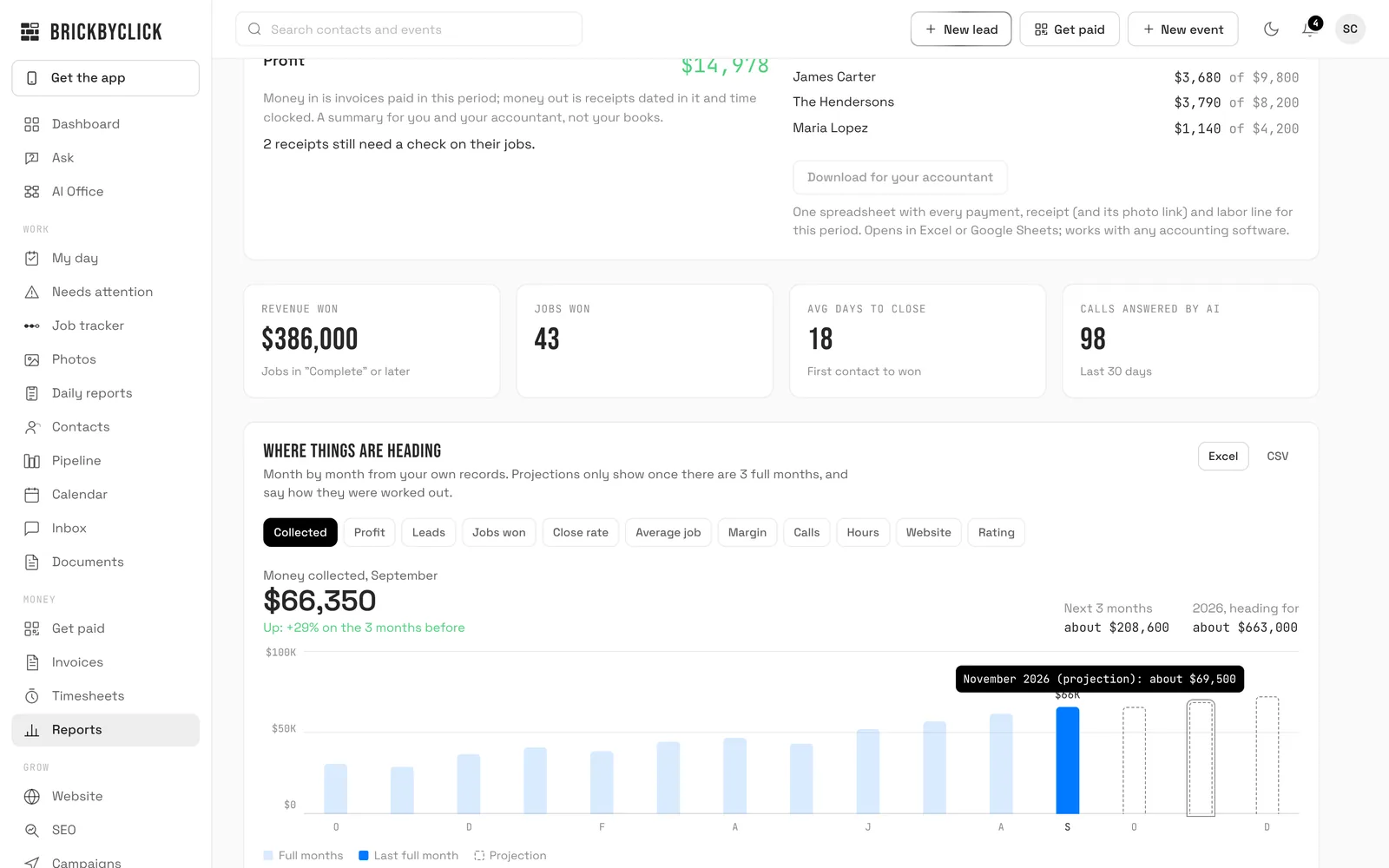
On the 1st your monthly business report arrives, and it has a Google search section and a map rankings section. More on that in business reports.
How do AI assistants and Google answers pick local businesses?
No one outside these companies knows exactly how an assistant picks the businesses it names. What we can say is what an assistant has to work with, and what we do about it.
What an AI answer is built from
When an assistant uses web search to answer "who is the best plumber in Austin?", it reads websites and listings and writes an answer from what it finds. Answers change from person to person and from day to day.
So the work is the same plain work as local SEO: have accurate, consistent details in places those answers read, and have a website that clearly says what you do and where.
What we do about it
- Ask the questions your customers ask. The AI search tab asks an AI with web search a set of questions, once a month, and records which businesses it names. Growth has 10 questions and Total Growth has 20. You can write your own.
- Show the websites it read. Open any answer to see which sites it used. A "Websites the AI reads" list lets you mark each one: not on it yet, working on it, on it, or not for us.
- Build a questions page from real calls. The AI receptionist records what callers ask. "Build it from my calls" drafts a page of answers from your receptionist settings and real calls, and leaves a "[Your answer: ...]" gap wherever it does not know. It never invents prices or hours.
- Check your website. The website check reads your home page, robots.txt and sitemap the way a search engine does and lists what to fix.
- Check the basics. A "What AI needs from you" list comes from the website check and your Bing and Apple listings.
What the score means
The page reports how many answers named you, your best spot, and who was named most instead. The check is a sample asked the same way each month, so you can see whether it is moving.
It is not a ranking and not a guarantee. A month where you are not named does not mean something broke.
How long does local SEO take and what affects it?
Months, not days. We will not give you a date, because no one can.
What happens when
- First weeks: your profile, your listings and your website's basics are set up or fixed.
- Every month after: new posts, a profile kept current, more reviews and more listings checked.
- Over the months: Google finds the changes and decides whether to trust them. Some months move more than others, and a month can go backwards.
What affects how fast
- Your town and your trade: more competitors for the same search means a longer climb.
- Your reviews: how many you have, how recent they are and how you reply.
- Where you start: a business with no profile and no listings has more to gain than one with a well-kept profile, and also more to build.
- Your website: whether there is a page for each service and town, and whether it is live and readable.
- Distance: how close you are to the people searching. This one cannot be changed.
- How much you give us: photos, the questions your customers ask and prompt answers on your details.
Who is local SEO for, and when is it not worth it?
Do I need local SEO?
You do if customers look for your trade online by town, and you want some of those customers to be new ones. You may not if all your work comes from repeat customers and referrals and you are already full.
A good fit if
- You serve a town or service area and customers search for "your trade near me".
- You want steady new customers that are not tied to paying for ads every month.
- You are able to wait several months before judging the results.
- You already take reviews seriously, or you are willing to start.
- You have a live website, or you will use the one that comes with your plan.
Not the right fit if
- You need jobs this week. Local SEO is slow, so ads or referrals will help faster.
- You work in a place with a very small number of searchers and are already booked out.
- You want a guaranteed ranking or a guaranteed number of calls. We do not sell either.
- You are on Starter, which has no SEO. You would move up to Growth first.
- You are not able to answer questions about your business or give us photos and details.
When is local SEO not worth it?
- When your business is not ready to take more calls. More search visibility means more calls, and an AI receptionist helps only if you can do the work.
- When your website is not live or your business details are changing every month.
- When you need the result in weeks, not months.
Local SEO by trade
The work is the same for every trade. What changes is the services, the words customers use and the competition.
- Plumbers and drain cleaners: emergency searches and service pages like water heater repair and drain cleaning.
- HVAC: seasonal searches for furnace and AC work, and a profile that lists each service.
- Electricians: pages for panel upgrades, EV chargers and repairs, plus license details on your site.
- Roofers and contractors: pages for each town, photos of finished work and reviews with a job type.
- Cleaners and landscapers: the neighborhoods you serve and photos, because customers compare before they call.
- Other trades: pest control, garage doors, painting, movers and more, in 30+ industries.
Local SEO compared with other ways to get found
These are the choices a service business usually weighs. None is wrong; they do different jobs.
| Option | Who does the work | How fast | What to watch |
|---|---|---|---|
| Monthly local SEO with BrickByClick (Growth, Total Growth) | Our team, with drafts you approve | Setup first, rankings over months | No guarantees. It sits next to your CRM, receptionist and website. |
| Doing it yourself with the SEO page | You | Depends on your time | The page writes drafts and checklists, but you copy, post and send. Nothing is posted for you. |
| Paid ads | You or an agency | Fast | They stop when the budget stops, and each click costs money. |
| A freelancer or a local SEO agency | A separate provider | Months | The work lives outside your CRM, so tying it to your jobs and payments takes effort. Ask what you will see each month. |
| Referrals and word of mouth only | Your customers | Slow and uneven | Good for repeat work. It does not reach people who do not know you yet. |
Many businesses do more than one. Local SEO and paid ads can run together, and referrals feed your reviews.
What does local SEO cost with BrickByClick?
Local SEO is part of a plan, not a separate fee. Plans are month to month with no setup fees.
- Growth, $599 a month: 1 blog post a month, a managed Google profile, directory listings built and fixed by our team, a monthly strategy call, map rankings for 3 keywords and 10 AI search questions.
- Total Growth, $999 a month: everything in Growth plus 2 blog posts a month, local link building, weekly map rankings for 5 keywords with competitors and suggestions, and 20 AI search questions.
- Starter, $99 a month: no SEO.
Both include the rest of the system: the CRM, the AI receptionist, the website, payments and reports. See Front Office for what the base plan has, and compare all plans.
Card payments in the CRM carry Stripe's processing fee plus 0.5% per payment (maximum $25), and bank payments have no BrickByClick fee. That is separate from SEO.
What local SEO with BrickByClick does not do
- It does not promise a ranking, a number of calls or a date. Google decides.
- It does not post for you. Google posts, review replies and link request emails in the CRM are drafts you copy and send yourself.
- It does not read your Google profile. The 11 profile checks and the directory statuses are ticks set by hand, by you, or by our team on Growth and above. It does not check that a listing exists.
- It does not publish on its own. Approving a blog post tells our team to put it on your website. How long that takes is not fixed, and you get a message when it is live.
- It does not measure everything. Map rankings cover Google Maps only, for the keywords you put on the map, from a grid around your center. The results table counts only customers who said how they found you.
- It does not edit a website built elsewhere. It counts visits and form messages on that site, and the website check reads your home page, robots.txt and sitemap only.
- It does not send texts. Review requests are emails.
- It does not replace good work. Reviews come from jobs done well.
Questions people ask
What is local SEO for service businesses?
How much does local SEO cost for a small business?
How long does local SEO take to work?
Can you guarantee I will rank first on Google?
Is local SEO worth it for a small plumbing or HVAC business?
Local SEO vs paid ads: which is better for a service business?
Can I do local SEO myself?
What is the difference between local SEO and Google Business Profile?
How do AI assistants decide which local businesses to recommend?
What does BrickByClick do to help me show up in AI answers?
How do I know if my local SEO is working?
Does BrickByClick local SEO come with a contract?
Do I need a website to do local SEO?
Find out where you stand today
Fifteen minutes. We will look at how people find you now and show you what the monthly work would look like for your business. We will not promise a ranking.